
Key takeaways
- The Marrakech to Fes desert route runs through Ait Benhaddou, the Dades Valley, Merzouga, and Midelt, and works best over four days and three nights.
- Ait Benhaddou is a fortified earthen ksar inscribed on the UNESCO World Heritage List in 1987, and it sits a short detour off the main road.
- Keep daily driving to roughly four to six hours so you have time to stop, walk, and reach each overnight town before dark.
- Merzouga is the base for Erg Chebbi, where most travelers ride camels into the dunes and sleep at a desert camp.
- A private driver removes the stress of mountain passes, unmarked turnoffs, and long rural stretches, leaving you free to enjoy the scenery.
The Marrakech to Fes desert route is a four-day drive that crosses the High Atlas Mountains, threads through desert valleys, and reaches the Sahara dunes at Merzouga before climbing north to Fes. Most travelers cover it in four days and three nights, stopping at Ait Benhaddou, the Dades Valley, Merzouga, and Midelt along the way. This guide walks through each leg so you know how far you drive each day, where to sleep, and what to see.
This is one of the most popular overland journeys in the country, and for good reason. In a single trip you pass through mountain passes, palm oases, film-set kasbahs, and the golden sand sea of Erg Chebbi. Morocco welcomed 17.4 million visitors in 2024, a record year (Atalayar, 2025), and a large share of them travel some version of this corridor between the two imperial cities.
What is the classic Marrakech to Fes desert route?
The classic Marrakech to Fes desert route leaves Marrakech heading southeast over the Tizi n'Tichka pass, reaches Ait Benhaddou and Ouarzazate, follows the valleys east through Dades and the Todra Gorge, drops to the dunes at Merzouga, then turns north to Fes through Midelt. It is a loop of distinct landscapes rather than a straight line.
Think of the trip in four driving days. Day one crosses the Atlas to Ait Benhaddou. Day two runs east along the Valley of a Thousand Kasbahs to Dades or Todra. Day three reaches Merzouga for the desert night. Day four is the long haul north to Fes. Each day has a clear destination, which keeps the pace manageable.
Because the route climbs high over the mountains early on, the scenery changes fast. You start among olive groves outside Marrakech, cross bare rock near the summit, then descend into red-earth valleys dotted with palms. Planning the drive around these shifts, rather than against them, is what makes the trip feel unhurried.
Which stops matter most: Ait Benhaddou, Dades, Merzouga, Midelt?
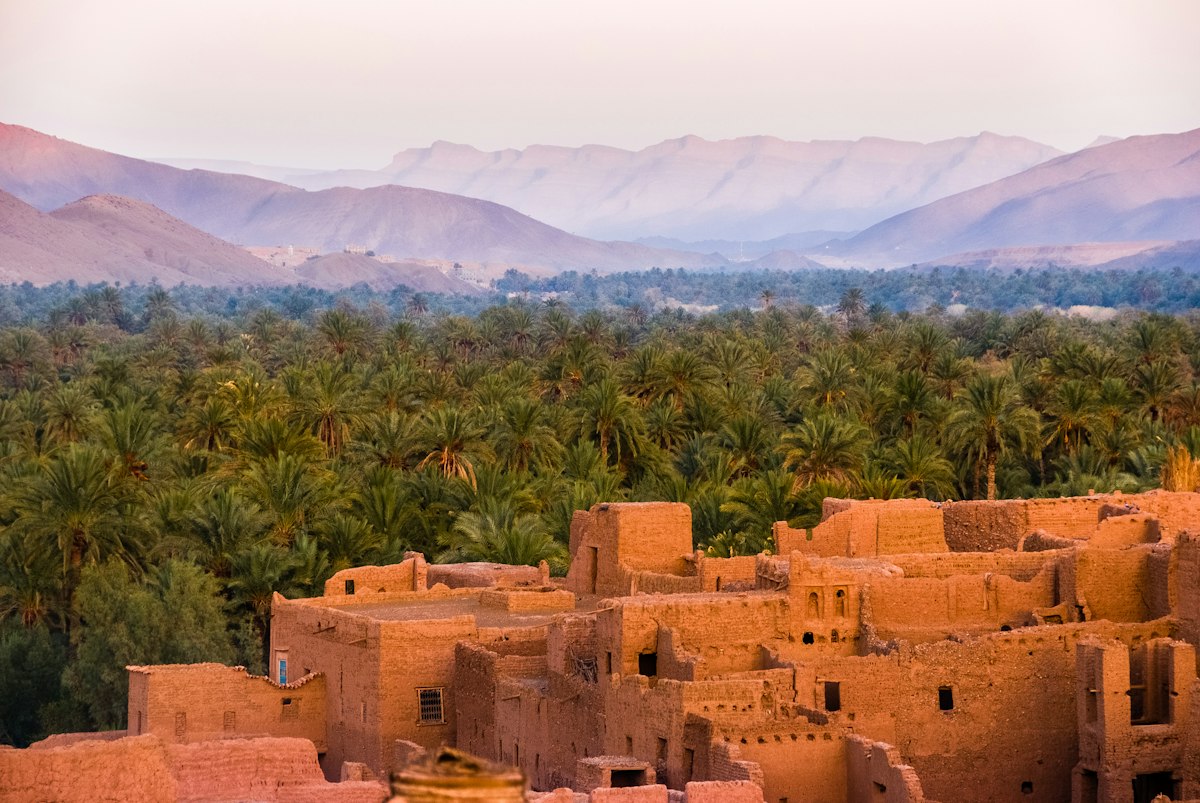
The four anchor stops are Ait Benhaddou, the Dades Valley, Merzouga, and Midelt, and each one marks a natural break in the drive. Ait Benhaddou is a fortified earthen village inscribed on the UNESCO World Heritage List in 1987 (UNESCO World Heritage Centre, 1987). It is the single most photographed stop on the route.
Ait Benhaddou is a ksar, a fortified cluster of mud-brick homes stacked against a hillside above a river. Walk up through its lanes to the old granary at the top for a wide view of the valley. The site has appeared in many films, so parts of it will feel familiar even on a first visit.
The Dades Valley comes next, famous for its ribbon of kasbahs and the twisting switchback road that climbs out of the gorge. Merzouga is the gateway to Erg Chebbi, the tall wind-sculpted dune field where most travelers ride camels and sleep under the stars. Midelt, high on the plateau between the Middle Atlas and the desert, is the practical lunch or rest stop on the final push to Fes.
How long are the driving times and daily distances?
Daily driving on this route runs roughly four to six hours, which leaves room to stop, eat, and explore without arriving after dark. The first day over the Tizi n'Tichka pass is the most demanding because of the altitude and the bends, even though the distance is modest.
Here is a realistic shape for the four days:
- Day 1: Marrakech to Ait Benhaddou. A half-day drive over the Atlas, with the pass and photo stops eating up time. You arrive in the afternoon with hours to spare for the ksar.
- Day 2: Ait Benhaddou to Dades or Todra. An easy day east through Ouarzazate and the kasbah valley, with plenty of short stops.
- Day 3: Dades to Merzouga. A longer stretch east, timed to reach the dunes before sunset for the camel ride.
- Day 4: Merzouga to Fes via Midelt. The longest day on the road, climbing steadily north across the plateau into the Middle Atlas cedar forests.
The numbers matter less than the rhythm. If you try to add the Todra Gorge, a long kasbah tour, and the dune ride into one day, you will spend the evening driving instead of watching the sunset. Spreading the highlights across four days keeps each one enjoyable. Spring and autumn offer the best balance of mild driving weather and comfortable desert nights.
Where should you overnight along the journey?
The standard overnight pattern is one night near Ait Benhaddou or Ouarzazate, one night in the Dades or Todra area, and one night at a Merzouga desert camp. This spacing matches the natural driving breaks and puts you in the right place for each morning's highlight.
Near Ait Benhaddou you can stay in a small guesthouse with a view of the ksar, which is lovely at dawn when the earthen walls glow. In the Dades Valley, hotels perched above the gorge give you the switchback road right outside the window. These are quiet, scenic bases rather than busy towns.
The Merzouga night is the one people remember. Most travelers trade the car for a camel at the edge of the dunes, ride in for about an hour, and sleep in a tented camp on the sand. Dinner, drumming, and a sky full of stars are the usual program. If you prefer not to ride, many camps arrange a 4×4 transfer instead. Pack a warm layer, because desert nights cool down quickly once the sun drops.
What are the highlights not to miss on each leg?
Each leg has a signature experience worth slowing down for, from the Atlas pass on day one to the cedar forests near Fes on day four. Planning around these keeps the drive from feeling like pure transit.
On the first leg, the Tizi n'Tichka pass is the star. Pull over at a viewpoint near the top to look back over the ridges you just climbed. The air is thin and cool, a sharp contrast to the heat waiting in the valleys below.
The middle legs are about valleys and villages. Walk through Ait Benhaddou in the soft morning light, drive the Dades switchbacks, and if time allows, step into the narrow slot of the Todra Gorge where cliffs rise straight up on both sides. The approach to Merzouga delivers the first sight of the dunes rising from flat desert, which never fails to surprise.
The final leg surprises many travelers. The climb from Midelt toward Fes passes through the Middle Atlas, where cedar forests and troops of Barbary macaques replace the desert. Arriving in Fes, you swap open road for the dense lanes of the old city, where the medina's maze of alleys makes a fitting end to a cross-country drive.
Why does a private driver make this route seamless?
A private driver turns a logistically tricky route into a relaxed trip, because someone else handles the mountain passes, the unmarked turnoffs, and the long rural stretches. You keep your eyes on the scenery instead of the map, and you can stop whenever a view is worth it.
Self-driving is possible, but the challenges add up. The Tizi n'Tichka has blind bends, rural roads have livestock and few fuel stations, and some of the best viewpoints are easy to miss without local knowledge. A driver who runs this road often knows where the quiet photo stops and the good lunch spots are.
This is the kind of journey Morocco View Travel is built around. We run private, customized tours with local drivers and comfortable vehicles, so you can shape the itinerary, linger where you like, and skip the stress of navigation. If you want to tailor the stops or the pace, our guide on how to plan a custom Morocco itinerary is a good starting point.
Start planning your cross-country drive
The Marrakech to Fes desert route rewards a little planning: four driving days, three well-placed overnight stops, and a pace that leaves room for the mountains, the kasbahs, and the dunes. Map your four days first, book your Merzouga camp early, then fill in the detours that interest you most. From there, decide whether you want to drive it yourself or hand the wheel to a local driver and simply watch Morocco roll past the window.
Frequently asked questions
How many days do you need for the Marrakech to Fes desert route?
Four days and three nights is the comfortable standard. You overnight near Ait Benhaddou or in the Dades Valley, spend a night at the Merzouga dunes, then drive to Fes through Midelt. Three days is possible but rushed.
Can you do the Marrakech to Fes tour in reverse?
Yes. Fes to Marrakech tours follow the same road in the opposite direction. The stops and driving times are identical. Many travelers pick the direction that matches their flight arrival and departure cities.
Is the Marrakech to Fes desert route safe to drive?
The main roads are paved and generally in good condition, but mountain passes have sharp bends and rural sections have livestock and few services. Many visitors hire a private driver so they can watch the landscape instead of the road.
What is the best time of year for this road trip?
Spring and autumn are ideal. Summer days in the desert get extremely hot, and winter nights near Merzouga and over the Atlas passes turn cold. March to May and September to November balance comfortable driving with pleasant desert evenings.